

A look inside the life and mind of an Aware Parenting Coach, and her expertise on conscious parenting
31 July 2025
| Last updated on 31 October 2025
Editor's Note: Main image for illustrative purposes only.
Here's how expat parents can raise their kids abroad with aware parenting.
In this interview, we chatted with trained Aware Parenting Coach and Founder of Kisari Kids, Hungarian expat Eva Szorad, who opens up about her journey into this transformative parenting philosophy.
She shares how her time living abroad reshaped her perspective, deepened her empathy, and continues to influence the way she supports families today.
Q. Hi Eva! Please introduce yourself to our readers.
"I’m Eva Szorad, an Aware Parenting Coach, a mother to a wonderful 3-year-old girl, and a wife to an amazing man. I’m a heart-driven human being, deeply passionate about helping others reconnect with their emotions, feelings, and innate wisdom. My journey started in the corporate world, but like it does for many women... motherhood brought a profound shift. It slowed me down and taught me to appreciate aspects of life I hadn’t valued before: presence, connection, emotional healing, and barefoot shoes.
Today, I’m honoured to support parents on their own paths toward greater self-understanding, deeper bonds with their children, and a more natural, compassionate way of everyday life."

Pictured: Eva Szorad, Aware Parenting Coach and founder of Kisari Kids.
Q. For those new to the concept, how does Aware Parenting work?
"Aware Parenting is a respectful, compassionate approach to raising children that focuses on connection, emotional freedom, and cooperation instead of punishment, rewards, control, or power-over.
It’s based on understanding that all behavior is a form of communication, especially from babies and young children who don’t yet have the words to explain what they’re feeling or needing. At its core, it recognises that children are inherently good, cooperative, and capable of healing from stress and trauma, especially when they feel safe, seen, and understood.
Children naturally heal through emotional expression: by crying, pulling tantrums, and laughing in the safe presence of a loving adult who listens without judgment or distraction. These are not behaviours to be stopped, but healing mechanisms that allow the child to release inner tension and restore their sense of well-being.
Instead of trying to control or fix a child's behavior, Aware Parenting encourages parents to look beneath the behavior and respond with empathy, connection, and presence. When children feel safe enough to express their stored feelings, they can let go of stress, feel more connected, and return to their natural state of cooperation, joy, and resilience.
Instead of asking “How do I stop this?” it asks, “What is my child feeling? What are they trying to show me?”
Developed by psychologist Dr. Aletha Solter, Aware Parenting combines insights from attachment theory, neuroscience, and child development. It’s not permissive and it’s not authoritarian, it’s a third path that holds both kindness and clarity. It supports strong, secure parent-child bonds and raises children who are emotionally healthy, self-motivated, and connected."
Q. How has Aware Parenting Coach transformed your own approach to parenting?
"The first time I truly held space for my daughter’s feelings, something profound happened once she had finished her release. Her whole face lit up. Her eyes were smiling, and an almost eternal happiness seemed to shine through her. She radiated light and contentment; she was deeply at ease in her body, with us, and with life. It was phenomenal.
That moment deeply moved me. I found it so powerful that I decided to learn everything I could about Aware Parenting. I started reading all the books, and soon discovered there was a mentoring course to become a coach, which immediately sparked my interest. At first, I thought it would simply be the perfect way to deepen my understanding. But as time went on, I realized just how aligned I felt with the principles of Aware Parenting."

"I began to notice the absence of this approach almost everywhere; among families we knew, even strangers in the street. I had such a strong urge to share what I had learned with others, but I knew that offering unsolicited advice wasn’t the way. Mothers are already overwhelmed with opinions from in-laws, relatives, and strangers.
So I decided to complete the course and become an expert, to be able to offer this knowledge in a respectful and professional way. For those who feel there must be more to parenting than shouting, punishing, threatening, or feeling powerless in conflict… and who long to understand how to nurture true cooperation with their children."
Q. What are some common misconceptions people have about Aware Parenting?
"Some misconceptions stem from the general principles shared across all classical parenting approaches, while there are specific Aware Parenting related. Here are the 2-2 common ones I encounter:
“It’s permissive / lets children do whatever they want.”
"Aware Parenting is not a permissive approach. It includes clear, loving limits. The difference lies in how those limits are set: with connection and empathy, rather than punishment or fear. Children are guided, not controlled. Limits are communicated in a calm, firm, and loving way.
Instead of shaming or blaming, we use “I” statements to express our boundaries, making it clear that while we don’t approve of certain behaviors, we do acknowledge and validate the feelings behind them.
For example:
“I see that you’re feeling disappointed and angry, but I’m not willing for you to hit your sister.”
This way, the child feels seen and understood, while also learning that some behaviors are not acceptable—and that boundaries can coexist with empathy.
“It takes too much time or only works if you’re calm all the time.”
It doesn’t require extra time—it simply invites us to respond differently in the time we already spend with our children. Aware Parenting often reduces long-term stress and power struggles. And you don’t need to be calm 100% of the time. When we do lose our calm (because we all do!), it’s not failure—it’s an opportunity to repair and model authenticity. This approach is about real-life parenting, with real emotions, real challenges, and a deep respect for both the child and the parent."

“It’s just about gentle discipline.”
"While discipline is part of it, Aware Parenting is much broader. It addresses how children process stress, how emotional expression helps healing, how play builds connection and cooperation, and how attachment impacts behavior.
“Letting children cry is harmful.”
Aware Parenting makes a clear distinction between leaving a child to cry alone (which is harmful) and lovingly listening to a child’s feelings when they need to cry in the safety of our presence. Crying with support is healing and helps children release stress. It also highlights that soothing is not comfort. As much as we believe we are instinctively doing our best to help a child ease the pain, in reality, we do not provide real support.
We believe we’re being helpful or kind, but often, these actions come more from our own discomfort than from true compassion. It’s not that we’re unkind—it’s just hard to witness someone else’s pain, because we never really got the compassion that we were longing for. So instead of fully allowing their feelings, we try to make the emotions stop. Deep down, it’s about helping ourselves feel less overwhelmed. Helping our children ‘feel better’ is masking, repression. The source is pain and fear.
During my consultancy, I keep two goals in mind: to provide information and emotional support. There are so many general misconceptions when it comes to raising a child, and I believe in the power of knowledge. Knowledge builds self-confidence. The more you understand the reasons why your child does (or doesn’t) do something, the more equipped you are to handle it.
For example, I often hear parents desperately talking about their efforts to make their toddler follow a general rule—like not drawing on the wall. When I explain that children only begin to understand the concept of rules around the age of two, it’s often a huge relief. It lowers unrealistic expectations—both for the child and for the parent. It’s the reassurance that there’s nothing wrong with any of them. It’s simply not the time to leave a kid alone with a felt-tip pen just yet.
Another aspect I find deeply important is seeing the child within the parent. Parenting is not an inborn skill; it’s a learned one. We’re often more driven by our visceral reactions than by our true instincts—and those reactions are rooted in our own childhood. Our parenting is shaped by our early experiences. Our deeply held truths, as well as our limiting beliefs, are often established in those first years of life.
It takes effort and inner work to bring awareness to this, and to consciously decide what kind of parent we want to be. During my sessions, I always take time to explore the roots of these misconceptions and limiting beliefs. My work is about children—but I work with parents. And their emotions are just as important as their child’s."

Q. How do you support parents who are navigating emotional challenges like guilt, burnout, or frustration?
"The main focus of Aware Parenting is, of course, supporting children and their well-being. However, this approach also recognizes that parents bring their own histories, feelings, and unmet needs into the parenting journey. It encourages us to care for ourselves emotionally so that we can show up more peacefully and lovingly for our children. One of the key practices is having a listening partner—someone who can offer us a safe, non-judgmental space to express our feelings openly. Sharing our guilt, burnout, or frustration with a listening body helps release emotional tension rather than unconsciously passing it on to our children.
Aware Parenting also invites us to reparent ourselves. This means offering to ourselves what we might have missed as children—empathy, understanding, comfort, and unconditional acceptance.
In practice, this can look like:
- Inner listening: Pausing to acknowledge our feelings without judgment, much like we do for our children.
- Self-compassion: Speaking to ourselves with kindness and reassurance instead of criticism.
- Meeting unmet needs: Gently noticing what we longed for as children (e.g., nurturing, playfulness, safety) and finding ways to give those experiences to ourselves now.
- Allowing emotional release: Giving ourselves permission to cry, laugh, or express frustration in safe ways, mirroring the emotional healing process we support in our children.
By tending to our own emotions and learning to reparent ourselves, we gradually heal old wounds, reduce guilt and burnout, and cultivate a deeper sense of calm and connection in our parenting."

Q. How has your experiences as an expat woman shaped your approach to parenting and coaching?
"I’ve always loved traveling, but from my early adult years, I became consciously curious—eager to observe and learn from the places I visited and lived in. I wanted to understand what people did differently and how I could implement those insights into my own life for the better. I was mesmerized by the love of life in South Africa, and amazed by the well-organized structure, progress, and future-minded attitude in Dubai. Today, I embrace the slower pace of “island life” in Tenerife—being close to nature while still enjoying the benefits of a highly developed infrastructure.
The key theme in all my international experiences has been connection: to observe and accept, to make the effort to understand—without judgment. This mindset is deeply woven into both my parenting and my coaching. I believe this is why Aware Parenting resonates so deeply with me. Because it’s not a “how-to” method—it’s approach, an attitude, a way to see people and life.
No matter where you live in the world, or what kind of culture you’re part of, connection is key. It is the foundation of Aware Parenting."
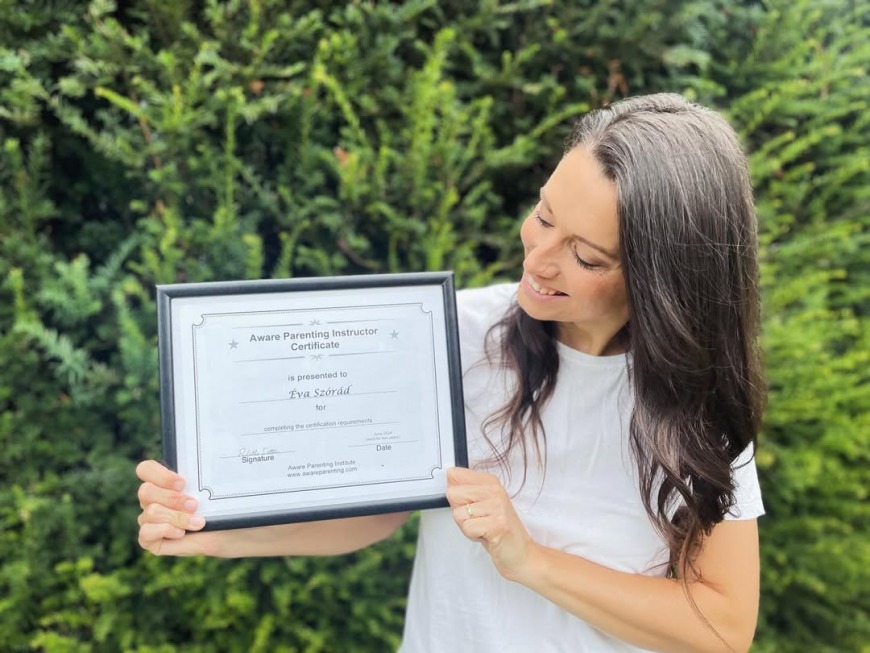
Pictured: Eva Szorad, Aware Parenting Coach and founder of Kisari Kids.
Q. What cultural differences have you observed when it comes to parenting styles?
"I have lived in Hungary, Slovenia, South Africa, and the UAE. Today, I reside in Tenerife, Spain. There are clear differences in everyday life and lifestyle, these variations also influence parenting styles.
What I find most fascinating (though it's a rather sad truth) are not the differences, but the similarities. Without exception, in every place I’ve lived, I’ve observed that disconnection tends to dominate family life. The influence of modern life, which constantly pushes us away from one another, is visible everywhere.
There are more and more products designed to “ease” parenting and help children be content on their own—without us. For example: smartphones, automatic stroller rockers, or the “breathing otter” toy that imitates the presence of a human lying next to a baby.
And there’s a real demand for these solutions. We live such fast-paced, time-consuming lives that we often don’t have the opportunity to truly be present with our children during those early, foundational years. The pressure on parents is enormous, and the “village” that everyone says it takes to raise a child? It’s simply not available—unless you can afford to pay for it.
We simply don’t have time for our children, and society often pushes us to rush their independence, not allowing them to develop essential skills at their own pace. We constantly worry and try to compensate for a vague, undefined sense of lack by seeking occasional, extraordinary experiences—while the rest of the week feels like a race.
I say “we” because it includes me, too. I’m on a journey to learn how to better attune to my child’s needs, and how to recognize and listen to my own needs—the ones I’ve learned to silence over the years. As I parent my child, I am also reparenting myself.
It’s hard. Sometimes it’s messy. But it’s absolutely worth it.
I’m sending love to all the families who are struggling, and I hope they find as much guidance and comfort in the approach of Aware Parenting as I have."
Q. How do you build trust and connection with clients from different cultural or linguistic backgrounds?
"I offer consultations in both English and Hungarian, and I use the language of Aware Parenting in both. Terms like “loving limits” or “control patterns” may sound unfamiliar at first, but they come with clear explanations within the Aware Parenting framework.
When I begin working with a family, I always make sure to explain these concepts in detail—both their theoretical background and how they apply in everyday practice, before using the terms regularly in our sessions.
The language we use is incredibly important. I pay close attention to how parents describe challenging situations and how they responded to their children, because both intentions and misconceptions often show through the words they choose. This helps me better understand my clients’ thinking, emotional landscape, and parenting style.
By tuning in to the way they express themselves, I’m able to offer information and perspectives that truly support them in the most delicate, real-life moments of parenting.
Loving limits: We validate the feelings that is triggering the unwanted behaviour we are not willing to accept. “I see you are frustrated, but I am not willing for you to break your toys.’
Control pattern: Any type of repetitive behavior either done by the parent or the child in order to cause distraction and repress the feelings bubbling up. E.g. rocking or thumb sucking."
Q. Can you walk us through a particularly memorable breakthrough you've witnessed with a family you’ve worked with?
"I had a family: parents of different nationalities, all living abroad with their child. They were lovely, loving people who, like most parents, wanted the best for their child. They believed that by giving the child everything they wished for in the moment, and by fixing even the smallest distress, they were creating the conditions for a happy childhood filled with constant fun and joy.
But every five minutes, the child was upset about something—whining nonstop, showing anything but immense happiness. The parents occasionally tried to set limits, but it always ended in a sudden, intense tantrum. Each time, they shut it down by quickly finding a way to cheer the child up.
From the Aware Parenting perspective, this child never had the chance to truly express any struggles or heavy feelings. Those unexpressed emotions were simply bubbling up in their body, day after day.
We had a consultation, and the parents were introduced to the concept of listening to feelings—with love and presence. In the beginning, it was difficult for them. The urge to make the child stop crying was strong, and they had to face their own emotions as well. But they were brave and persistent. After just two or three occasions, they began to notice a real difference in their child’s behavior, mood, attention span, and level of cooperation.
Today, they are what I call an Aware Family. They no longer try to make distress disappear instantly. They understand that what allows a child to truly experience happiness is the ability to process emotions. They know that resilience is built through the capacity to face and cope with feelings in a safe, welcoming way—and that when we do, those feelings naturally pass.
I hope every day that these parents are incredibly proud of themselves. They made a huge change, for the better, for all three of them."